Road bike on a trainer
A road position with real fit findings -- what to change, in fitting order, with the measurement each one fired on.
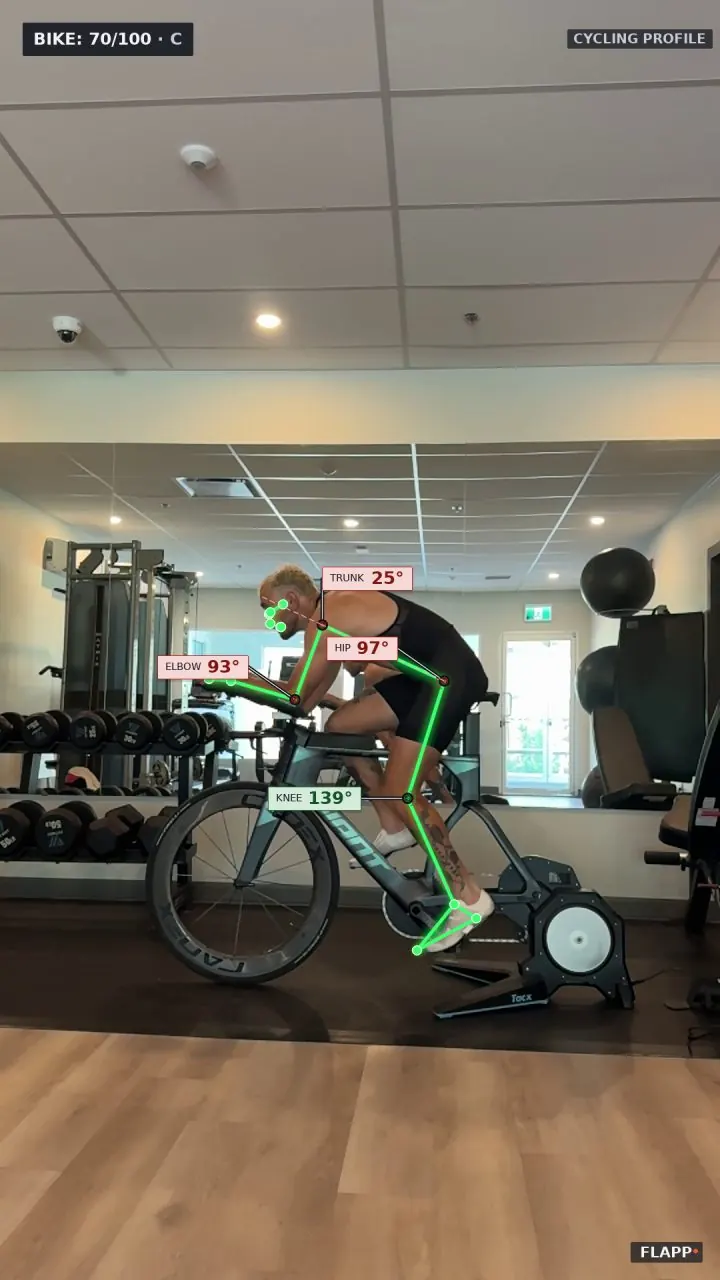
Scored on 9 of 9 measures — 100% of the rubric.
Measured against published ranges
Every target names where it comes from. A value a degree or two outside a band is inside the method’s own error, not a finding.
| Measurement | Yours | Reference | Source |
|---|---|---|---|
| Knee at the bottom of the stroke | 149.9° | 135–145° | Retul; Bini et al. 2011 |
| Knee at the top of the stroke | 62.1° | 65–75° | |
| Hip angle | 72° | 50–65° | Retul; derived from competitive rider trunk 30-45 deg |
| Elbow angle | 93.6° | 130–160° | Retul road fit window |
| Trunk angle | 23.1° | 30–45° | Competitive road rider norms |
| Shoulder angle | 88.3° | 85–110° | |
| Forearm tilt | 17.3° | 0–15° | |
| Pelvic tilt ratio | 3.1 | 1.8–3.5 |
Findings
- trunk too aggressive — 23 deg
What to change on the bike
In fitting order: each change moves the ones below it.
- saddle height — Knee angle at BDC is 150 deg (optimal 135-145 deg). Overextension -- lower saddle by 5mm, ride 30 min before reassessing.
- bar position — Trunk angle is 23 deg (optimal 30-45 deg). Position is too aggressive -- raise stem spacers and stem angle for a more sustainable position.
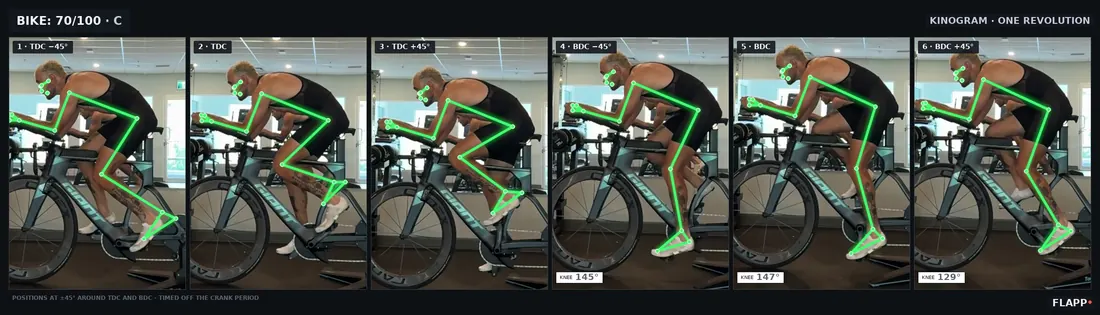
One pedal revolution
Six positions either side of the top and bottom of the stroke, timed off the crank period rather than off frame counts.
What the recording cost the measurement
Verdict: poor. Every analysis says how the clip limited it, and what to change next time.
| Check | Measured | Target |
|---|---|---|
| Problem: How much of the frame you fill | 237 px tall (19% of the frame height) | 550 px or more — roughly two thirds of the frame height |
| Needs attention: How long the clip runs | 25.3 s | 5-10 s of steady movement |
| Good: The angle you filmed from | side on (depth ratio 0.678) | filmed square-on to your side, so the joints move across the lens |
| Good: Which way you held the phone | portrait (1080x1920) | portrait — a tall frame puts nearly twice the pixels on your legs |
Measured from a single side-on camera with 2D pose estimation. Only the near side of the body is measured; the far side is absent rather than assumed symmetrical. Reference ranges are efficiency targets from the literature, not diagnoses.
Film ten seconds and get your own
Side-on, phone upright, you filling the frame. Free account, no card.
Analyze your form — free